Table of Contents
- The Short Answer: What to Actually Buy First
- Why Home Gyms Turn Into Clothes Racks (and How Not to Be One)
- Phase 1: The $150 Starter Kit[+]
- Phase 2: Adjustable Dumbbells, a Bench, and Your First Rack[+]
- Space and Ceiling: What You Actually Need Before You Buy a Rack[+]
- Phase 3: Filling It Out
- New vs. Used: Where It’s Safe to Save Money
- Keeping It Running
- The Bottom Line
- FAQ[+]
Build a home gym in three budget phases, spreading purchases across separate rounds. Phase one is a mat, resistance bands, a jump rope, and one pair of light adjustable dumbbells, all under $150. Phase two adds a real bench and your first power rack once you’ve proven you’ll show up, usually $900 to $1,500. Phase three fills in heavier iron and cardio only after that. Skipping that order means betting on willpower you haven’t tested yet. One UK survey from gym-membership marketplace Hussle found that over a third of people had bought fitness equipment they never used, and 13% had bought a barbell or dumbbell set that never left the corner. This guide is for US adults setting up a first home gym, or rescuing one that already turned into a clothes rack.
The Short Answer: What to Actually Buy First
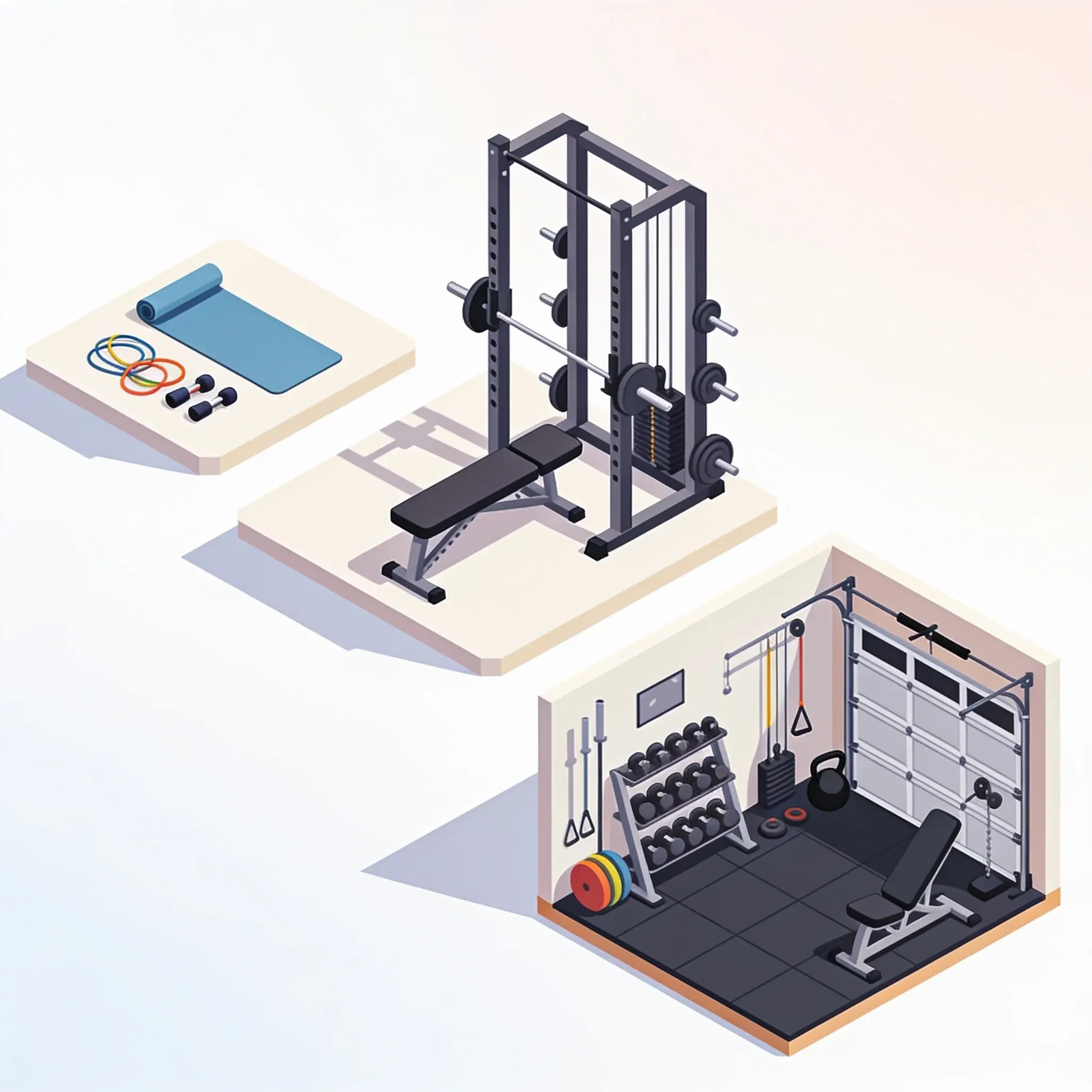
Buy in this order, and don’t skip a phase just because you can afford to. Each phase exists to test whether the one before it actually gets used before you spend more money proving the same thing at a higher price.
| Phase 1 | Phase 2 | Phase 3 | |
|---|---|---|---|
| Cost | Under $150 | $900–$1,500 | $1,500+ |
| What's in it | Mat, resistance bands, jump rope, one pair of light adjustable dumbbells | Heavier adjustable dumbbells, an adjustable bench, an entry-level power rack | Mid or premium rack, barbell and plates, a cardio machine |
| What it's for | Proving you'll actually train three times a week | Real strength training once the habit is real | Replacing a gym membership outright |
The gap between phase one and phase two is deliberate. Most people who quit a home gym quit somewhere in that gap, after the enthusiasm purchase and before the equipment earns its keep.
Why Home Gyms Turn Into Clothes Racks (and How Not to Be One)
Most home-gym failure comes down to follow-through. You can buy a $2,000 rack in an afternoon. Building a reason to walk over to it four times a week takes longer, and no product page mentions that part. That Hussle survey isn’t a fluke either; anyone who’s seen a garage corner with an unused bench under a pile of laundry has watched the same pattern play out locally.
- Buy for the workout you already do. The one you wish you did can wait until the first one is an actual habit. If you haven’t done a pull-up in three years, a $1,200 rack with a pull-up bar solves a problem you don’t have yet.
- Test with cheap gear before you upgrade. A $30 set of bands and a $20 mat will tell you in a month whether you’re actually training, before you’ve committed real money to find out.
- Put it somewhere you walk past every day. Equipment in a spare bedroom behind a closed door gets used less than equipment next to the coffee maker. Visibility beats capability almost every time.
Phase 1: The $150 Starter Kit
Everything in this phase is cheap enough that getting it wrong costs you an afternoon at most. You’re buying information about your own habits as much as you’re buying equipment.
The Mat
A basic exercise mat runs $15 to $35 and covers floor work, stretching, and anything you’d otherwise do on carpet or hardwood. Don’t overthink this purchase; a thin mat you actually roll out beats a thick one still in its box.
Resistance Bands
Bands come in tension ranges, and the spread matters more than the brand. A beginner multi-band set with several tension levels typically costs $10 to $60. Prioritize a set spanning light to mid tension for versatility. You’ll use the light one for warm-ups and mobility work far more often than a single heavy band allows.
| Tension Level | Resistance Range | Best For |
|---|---|---|
| Light | 5–15 pounds | Warm-ups and mobility work |
| Mid-range | 25–80 pounds | General strength training |
| Heavy | 120–170 pounds | Advanced resistance work |
| Heavy-duty | Up to 250 pounds | Specialized heavy movements |
For specific movements to do with them, our breakdown of resistance band exercises walks through a full session.
Jump Rope
A jump rope is one of the cheapest items in phase one. It’s loud on a hard floor and needs a mat or rug underneath in an upstairs unit, but it packs a real cardio session into ten minutes.
One Pair of Light Adjustable Dumbbells
Round out phase one with a single pair of adjustable dumbbells at the low end of the market. You’re testing whether you’ll pick them up three times a week before you build out a permanent collection. Save the heavier, pricier adjustable sets for phase two once you know the answer.
Phase 1 checklist:
- Exercise mat ($15-$35)
- Multi-tension resistance band set ($10-$60)
- Jump rope (basic models widely available at low cost)
- One pair of light adjustable dumbbells (entry-level pricing)
Phase 2: Adjustable Dumbbells, a Bench, and Your First Rack
Move to phase two only after phase one has actually been used for a few weeks straight. Real money enters the picture here, and a wrong purchase costs more to undo.
Adjustable Dumbbells
The Bowflex SelectTech line offers models for different strength levels. The 552 alone replaces 15 separate pairs of fixed dumbbells, which matters a lot in a spare room or garage corner.
| Model | Weight Range | Price Range | Best For |
|---|---|---|---|
| SelectTech 552 | 5–52.5 lbs (2.5-lb increments) | $349–$429/pair | General home training |
| SelectTech 1090 | 10–90 lbs | — | Advanced/heavy lifting |
There’s a recall to check before you buy either one, new or used. Weight plates on both models can dislodge from the handle during use. The Consumer Product Safety Commission recalled the affected units on June 5, 2025. Roughly 3.84 million dumbbells were covered. Nautilus, the brand’s former owner, logged 337 incident reports including 111 injuries. Johnson Health Tech, the current owner, logged 12 more reports with no injuries attached. Before you buy, check the CPSC recall notice and remedy instructions to verify the unit is safe.
The Bench
The sweet spot for a bench that holds up under real loading is $250 to $430. Below roughly $150, stability under heavy loads starts to become a real concern, and above about $500 you’re paying for features that don’t move the needle unless you’re headed toward commercial-grade equipment. Weight capacity in that range typically runs 600 to 1,500 pounds, comfortably covering essentially every home lifter. For a broader look at what else fits in this budget range, our exercise equipment roundup covers additional picks.
Your First Rack
Entry-level racks start around $300 to $400. Fitness Reality’s 810XLT and REP’s PR-1100 both sit in that range and cover the same basic job. Commercial gyms use heavier-gauge steel and thicker uprights. An entry-level rack still holds a barbell safely for squats and presses, which is the whole job at this stage. If you’re deciding between a power rack and a Smith machine instead, that comparison is worth reading before you commit to either.
Space and Ceiling: What You Actually Need Before You Buy a Rack
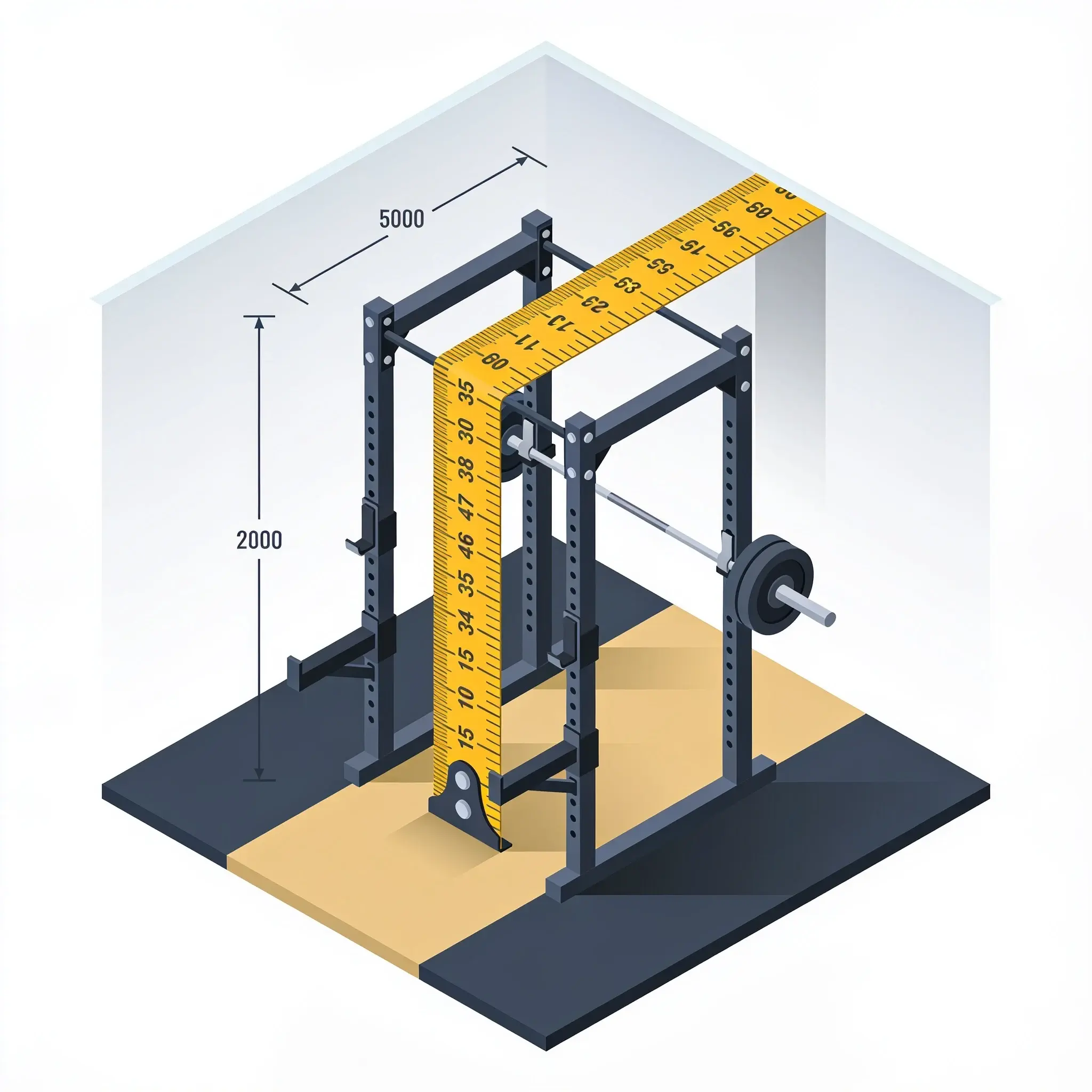
Measure your space before you measure your motivation. A rack that doesn’t fit is a returned rack, and return shipping on something that heavy isn’t cheap.
A typical power rack runs 40 to 52 inches wide and 24 to 50 inches deep. Height varies more, from 72 inches on compact models up to 96 on commercial-grade units. Ceiling clearance matters as much as floor footprint. Most racks need roughly 18 to 24 inches of open space above the top bar for pull-ups and overhead pressing, which puts the practical minimum ceiling height around 8 to 9 feet.
Apartments, Garages, and Basements
Apartment setups have their own constraints beyond square footage. Impact noise from dropped weights travels through floors more than most people expect. A thick mat or dedicated lifting platform under the rack isn’t optional in a shared building — it separates a home gym from a noise complaint. Garages solve the noise problem but bring temperature swings that can rust uncoated steel faster than an indoor setup. Basements split the difference. Check ceiling height carefully, since finished basements often clip a foot or two off the number you’d get in a garage, and low ceilings rule out overhead pressing inside the rack entirely.
Vertical storage earns its keep in any of these spaces. Wall-mounted band hooks, a pegboard for plates, and a rack with built-in weight storage all keep a small footprint from turning into a tripping hazard.
Phase 3: Filling It Out
Phase three is where a home gym stops supplementing a membership and starts replacing one outright, if that’s the goal. Mid-range 11-gauge racks run $600 to $1,100. REP’s PR-4000 is a common pick in that tier. Premium builds from brands like Rogue or REP’s heavy-duty lines climb past $1,200, sometimes well past $2,000. Add a barbell and a set of plates, and you’re at a setup that covers squats, presses, and pulls without leaving the room. If you want rugged, daily-abuse picks in this tier, our tough stuff home gym roundup covers heavier-duty options.
Don’t let strength work crowd out cardio entirely, though. The CDC’s activity guideline is a useful anchor here:
> Each week, adults should aim for 150 minutes of moderate-intensity activity, or 75 minutes of vigorous-intensity activity, or an equivalent combination, plus muscle-strengthening activity working all major muscle groups at least two days a week.
A rack full of iron covers the second half of that guideline well. The first half needs something else. A jump rope from phase one already covers cardio in short bursts, and a rowing machine or stationary bike is the natural phase-three addition if you want longer steady-state sessions without leaving the house. Neither needs to be expensive to do the job; the goal is minutes logged consistently, nothing more competitive than that.
New vs. Used: Where It’s Safe to Save Money
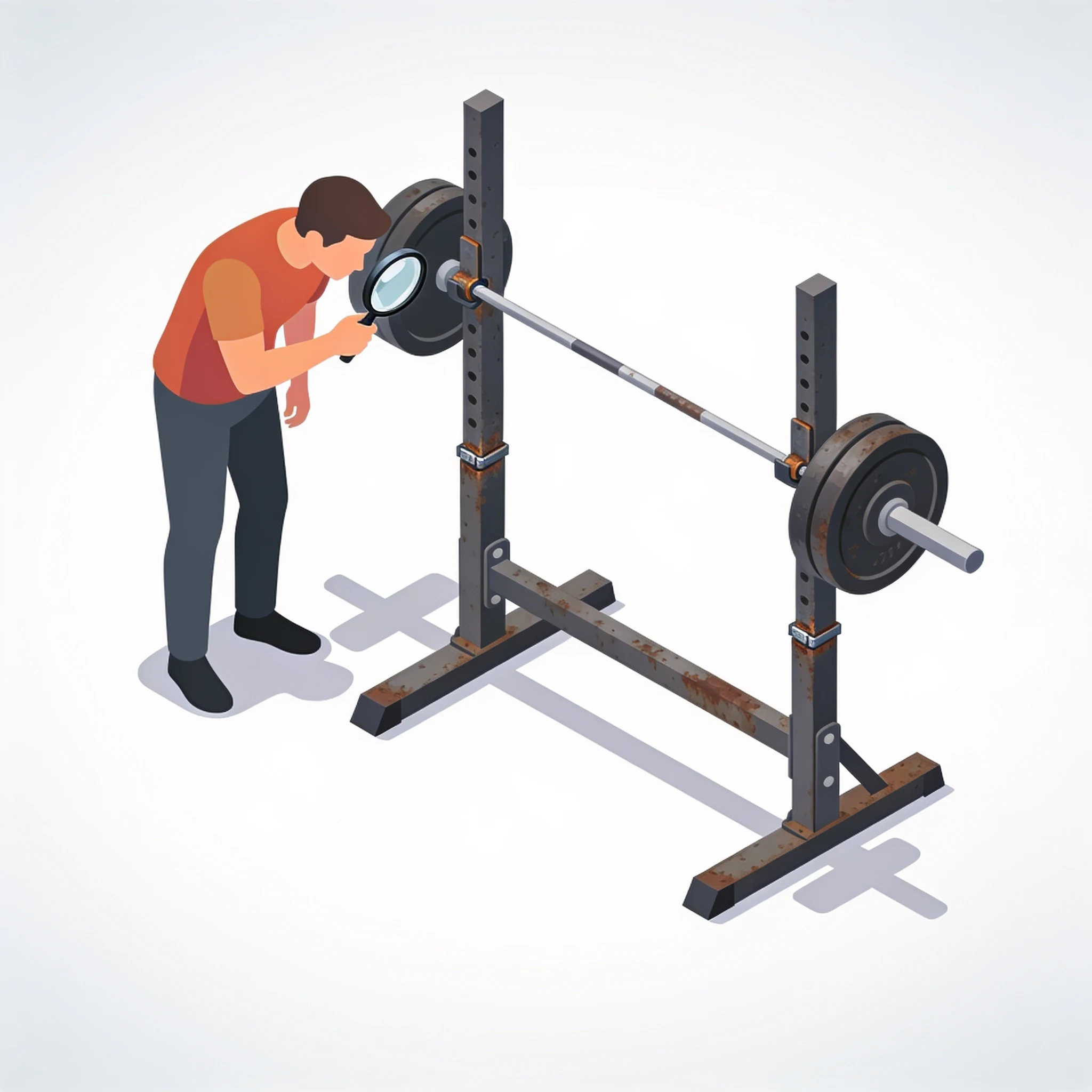
Buying used cuts the cost of phase two and three substantially, but not every item is equally safe to buy secondhand. Steel doesn’t wear out the way electronics or padding does, which is why racks and barbells are usually fine used while anything with moving mechanical parts deserves more scrutiny.
| Item | OK to Buy Used? | What to Check |
|---|---|---|
| Barbell | Yes, usually | Roll it on a flat surface; any wobble or hop means the bar is bent and it should be avoided |
| Power rack | Yes, with inspection | Welds intact, uprights not bent, bolt holes not stripped, J-hooks and safety bars secure and undamaged |
| Adjustable bench | Case by case | Frame free of rust, dents, or weak welds; padding without tears; locking mechanism on adjustable models actually locks; capacity matches your body weight plus load |
| Adjustable dumbbells (SelectTech-style) | Only after a recall check | Check against the CPSC recall notice before buying; the plate-dislodging defect is exactly the kind of thing a used listing won’t mention |
A rack or barbell that passes inspection is functionally identical to a new one at a fraction of the cost. Anything with a locking mechanism, a motor, or a known recall is where the savings stop being worth the risk if you skip the check.
Keeping It Running
Maintenance on home gym equipment is mostly about catching small problems before they become expensive ones. Wipe down steel after sweaty sessions, especially in a garage where humidity swings faster than indoors; bare steel that stays damp overnight can start to rust. Check rack and bench bolts every month or two and retighten anything that’s worked loose; a rack that shifts under load needs attention immediately, before you load it again. None of this takes more than a few minutes, and it’s cheaper than replacing a rusted-out rack two years early.
The Bottom Line
A home gym earns its cost back the same way a gym membership does. It has to actually get used. Start with the $150 kit, prove you’ll train on it, then move up a phase at a time. If you want specific product picks once you know which phase you’re buying for, our roundup of affordable home gym machines covers models across all three tiers, and our powerlifting belt reviews are worth a look once you’re loading a barbell regularly.
FAQ
How much does a basic home gym cost to start?
A phase-one setup, mat, bands, a jump rope, and one pair of light adjustable dumbbells, lands under $150. That’s intentionally the cheapest tier in the whole plan; the point is testing your own follow-through before spending more.
Do I need a power rack to get started?
No. A rack belongs in phase two, after you’ve already been training consistently on cheaper equipment for a while. Bodyweight work, bands, and adjustable dumbbells cover strength training for months before a rack becomes the limiting factor.
Is a home gym cheaper than a gym membership?
It depends on how long you stick with it and how much you spend. The average US gym membership runs about $50 a month, based on research surveying more than 22 gym chains. That works out to roughly $600 a year. A phase-two setup at the low end of its range breaks even against that in about a year and a half; a full phase-three build takes roughly four years to catch up. Either way, there’s no monthly bill after the equipment is paid off.
What’s the minimum ceiling height for a home rack?
Most racks need somewhere between 8 and 9 feet of ceiling height to leave enough clearance above the top of the rack for pull-ups and overhead pressing. Measure your actual ceiling, including any drop from ductwork or light fixtures, before ordering; a rack that’s technically short enough on paper can still clip a duct that runs lower than the rest of the ceiling.
Is it safe to buy a used squat rack?
Generally yes, as long as you inspect it in person before buying — listing photos can hide bent uprights and cracked welds. Check the welds, make sure the uprights aren’t bent, and confirm the J-hooks and safety bars are intact and undamaged. A rack has far fewer moving parts than a bench or an adjustable dumbbell handle, which is exactly why it’s one of the safest used purchases on this whole list.
What should I buy after the phase-one starter kit?
Until you’ve actually used the starter kit for a few weeks running, nothing comes next. Once you have, the next purchase depends on what you found yourself reaching for most. Buy heavier dumbbells if you kept maxing out the light pair, or a bench if floor-based pressing started feeling limited. Buying both at once before you know which one you need is how phase two turns into unused equipment sitting next to phase one.
This content is for general information only and is not medical advice. Consult a physician before starting any exercise or nutrition program.


Leave a Reply
You must be logged in to post a comment.