Table of Contents
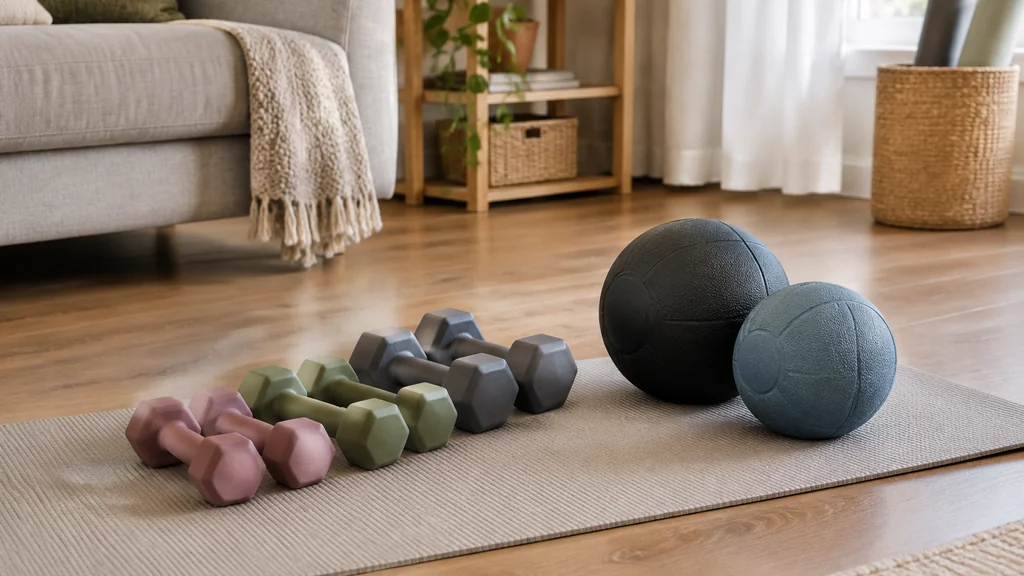
A beginner needs one pair of adjustable hand weights, one light pair, and one medicine ball that suits the throws you plan to do. Start with two sessions a week, add a small amount of weight only when every set feels controlled, and keep the ball work to throws and slams rather than heavy presses. That is the whole setup. Everything below is how to choose the numbers and what to do in the first month.
What a Beginner Actually Needs
Most people buy too much and quit by week three. The kit that survives that week is small.
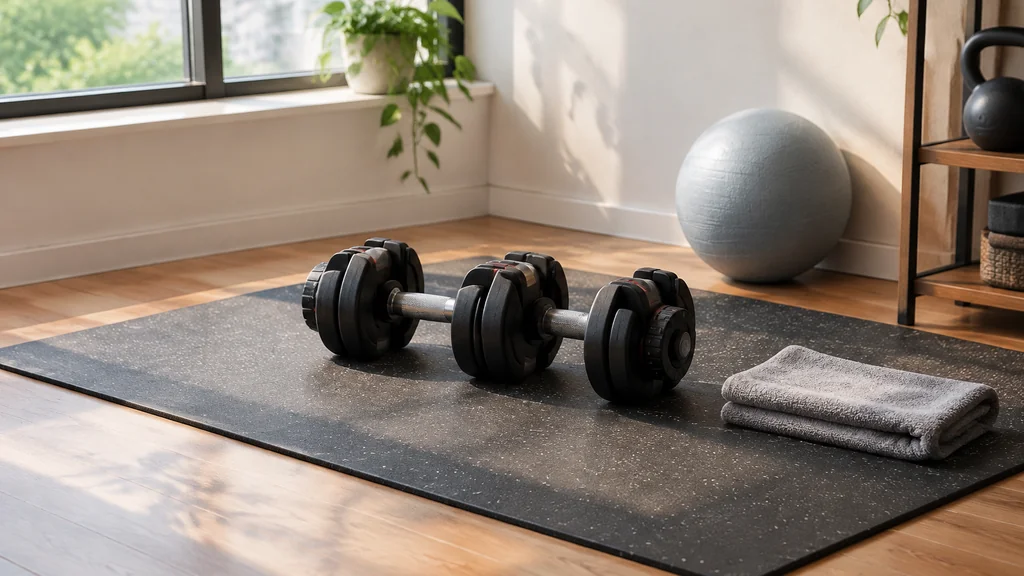
- One pair of adjustable dumbbells, or a fixed set of hand weights in two or three loads
- One medicine ball, light enough to throw at a wall without fear
- A bench or a sturdy step
- A mat if you train on a hard floor
A weight set that covers a range beats a rack of fixed pairs for a first purchase, because you can move in small steps. Small steps are the entire game. Add five pounds a week and in two months you’re at a number you’d have called impossible. Add twenty-five today and you’ll be nursing your lower back on Thursday.
If you are still deciding where to put the rack, the trade-offs between a cage and a guided bar are covered in this power rack vs Smith machine comparison, and the short version is that free weights ask more of you and give more back.
Choosing Loads Without Guessing
You cannot pick loads from a chart. You pick them from a test set.
Warm up, then take a pair you think is easy and do eight slow repetitions of a goblet squat or a floor press. If the last two reps slow down, the pair is too heavy for week one. If all eight feel the same as the first, go up one increment.
For most beginners, the working range for pressing and rowing sits well below what the legs can handle. That gap is normal and it is why a set of hand weights with small increments matters more than a set with a high top end.
Medicine balls are different. You are not grinding out reps, you are producing speed. A ball you can throw hard for a full set is the right ball. If your throws get slow and loopy by rep five, the ball is too heavy.
The First Four Weeks, Session by Session
Run this twice a week with at least two days between sessions. Add a third day only when both sessions feel easy.
- Warm up for five minutes with easy movement and a few bodyweight squats.
- Do a goblet squat with one hand weight, three sets of eight, resting a minute between sets.
- Do a floor press or bench press with both weights, three sets of eight.
- Do a one-arm row with one weight, three sets of ten on each side.
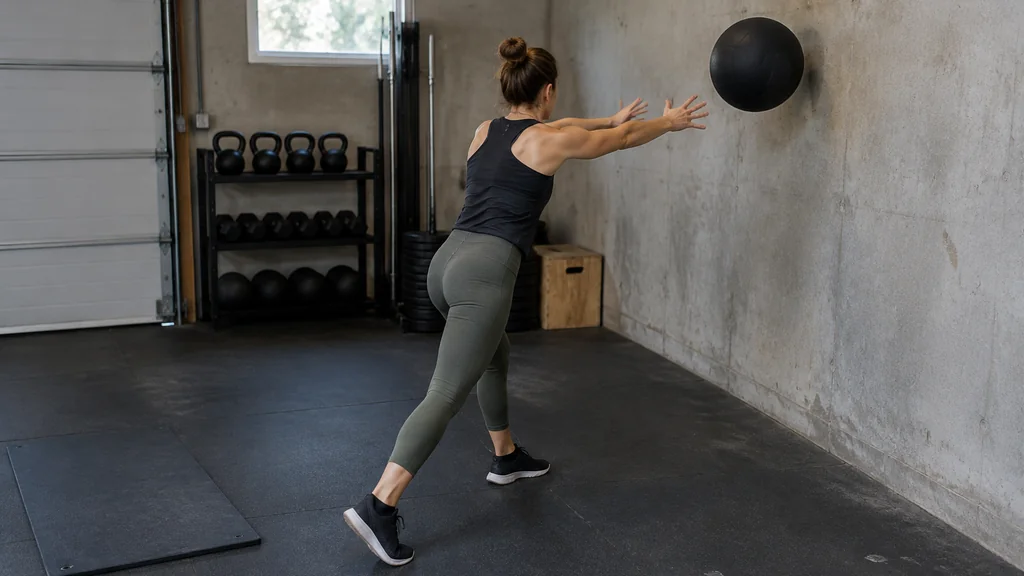
- Do a medicine ball slam or chest throw, three sets of six, focusing on speed over effort.
- Finish with a carry, holding both weights at your sides for a short walk, two rounds.
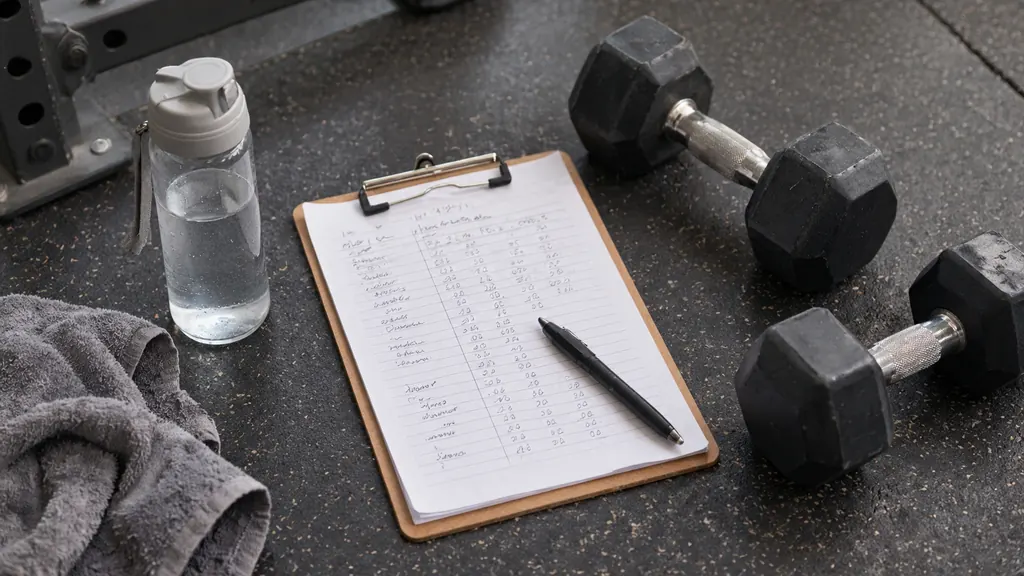
That is roughly thirty minutes. Log the weights you used. Next session, if every set felt controlled, take the smallest available jump on one exercise only.
Technique in two commands. For the squat, sit down between your feet and keep your chest tall. For the press, keep your shoulder blades pulled back and your feet flat.
Soreness in the first week is normal and it fades. Soreness that is sharp, one-sided, or in a joint is a signal to stop and check your setup.
Medicine Ball Work That Earns Its Place
A medicine ball is a power tool. Use it for throws, slams, and rotational work, not for long sets of presses.
Chest throws against a solid wall, overhead slams onto a mat, and rotational throws from a half-kneeling stance cover most of what a beginner needs. Keep the sets short, six to eight reps, and stop the set when the throw slows down.
Check the ball before you buy. A bouncy rubber ball behaves differently against a wall than a soft leather one, and a ball that rebounds hard is a poor choice for indoor throwing. The label usually tells you whether it is designed to bounce.
If you train in a garage or a shared space, keep the throwing area clear and store the ball where it will not roll underfoot. The same housekeeping habits that keep kit usable apply to training clothes, and this routine for handling workout attire keeps a small gym from turning into a pile.
Where Beginners Go Wrong
The mistakes repeat across every home gym.
- Buying a heavy ball first. You cannot throw it hard, so you learn nothing.
- Jumping loads because a session felt good. One good day is not a trend.
- Skipping the warm-up because the weights are light. Light weights still load cold tissue.
- Training to failure in week one. Leave two reps in reserve and you will still be training in week six.
- Ignoring the floor. Dropped weights crack tiles and annoy everyone downstairs.
There is a second category of mistake that has nothing to do with the weights. Kit that is uncomfortable, badly stored, or always in the wash gets in the way of the session. Gear that fits and lives in one place removes a reason to skip. The same principle applies to protective equipment in other sports, where fit decides whether you actually wear it, as this guide to what to look for in a baseball helmet explains.
When to Add Weight and When to Stop
Add weight when you complete every prescribed set and rep with control and the last rep of the last set still looks like the first. Add the smallest increment available, on one exercise at a time.
Stop the session when form breaks, when a joint hurts, or when you feel dizzy. Stop the program and see a physiotherapist or doctor if pain persists past a few days, if you feel numbness or tingling, or if a joint gives way.
Progress in the first two months is mostly coordination. The numbers move, but the bigger change is that the movements stop feeling foreign. That is the point of starting light.
Hand Weight Sets and Medicine Balls FAQ
How heavy should a beginner’s hand weights be?
Light enough that you can complete every set with two reps left in reserve. For most beginners that means starting well below what feels impressive and moving up in the smallest increments your set allows. Check the spec sheet on any adjustable set so you know the size of each jump before you buy.
Do I need both hand weights and a medicine ball?
No, but they do different jobs. Hand weights build strength through slow, controlled reps, and a medicine ball trains speed and rotation through throws. If you can only buy one, start with the weights and add a ball later.
Can I use a medicine ball for strength training?
You can, but it is a poor fit for heavy pressing or rowing because the ball is awkward to hold and hard to load progressively. Use it for throws, slams, and carries, and keep the strength work on dumbbells.
How many days a week should a beginner train?
Two full-body sessions a week is enough for the first month, with at least two days between them. Add a third session only when both existing sessions feel controlled and you are recovering well. More sessions in week one rarely survive to week four.
What should I do if a set feels too easy?
Finish the session as planned, then add the smallest available increment to one exercise next time. Do not add weight to every lift at once, and do not add reps and weight in the same week. Small, boring steps are what keep the plan running.
This content is for general information only and is not medical advice. Consult a physician before starting any exercise or nutrition program.