Table of Contents
- 1. SBD Knee Sleeves
- 2. Rehband Knee Sleeves
- 3. Stoic Knee Sleeves
- 4. Hookgrip Knee Sleeves
- 5. RockTape Knee Sleeves
- How to Choose the Right Knee Sleeve Thickness
- How to Measure for Knee Sleeves
- Frequently Asked Questions[+]
- Knee Sleeves vs Knee Wraps: What’s the Difference?
- How to Care for Your Knee Sleeves
- When to Replace Your Knee Sleeves
- Knee Sleeves for CrossFit vs Powerlifting
- What I Learned Testing 12 Knee Sleeves
- Do Knee Sleeves Actually Make You Stronger?
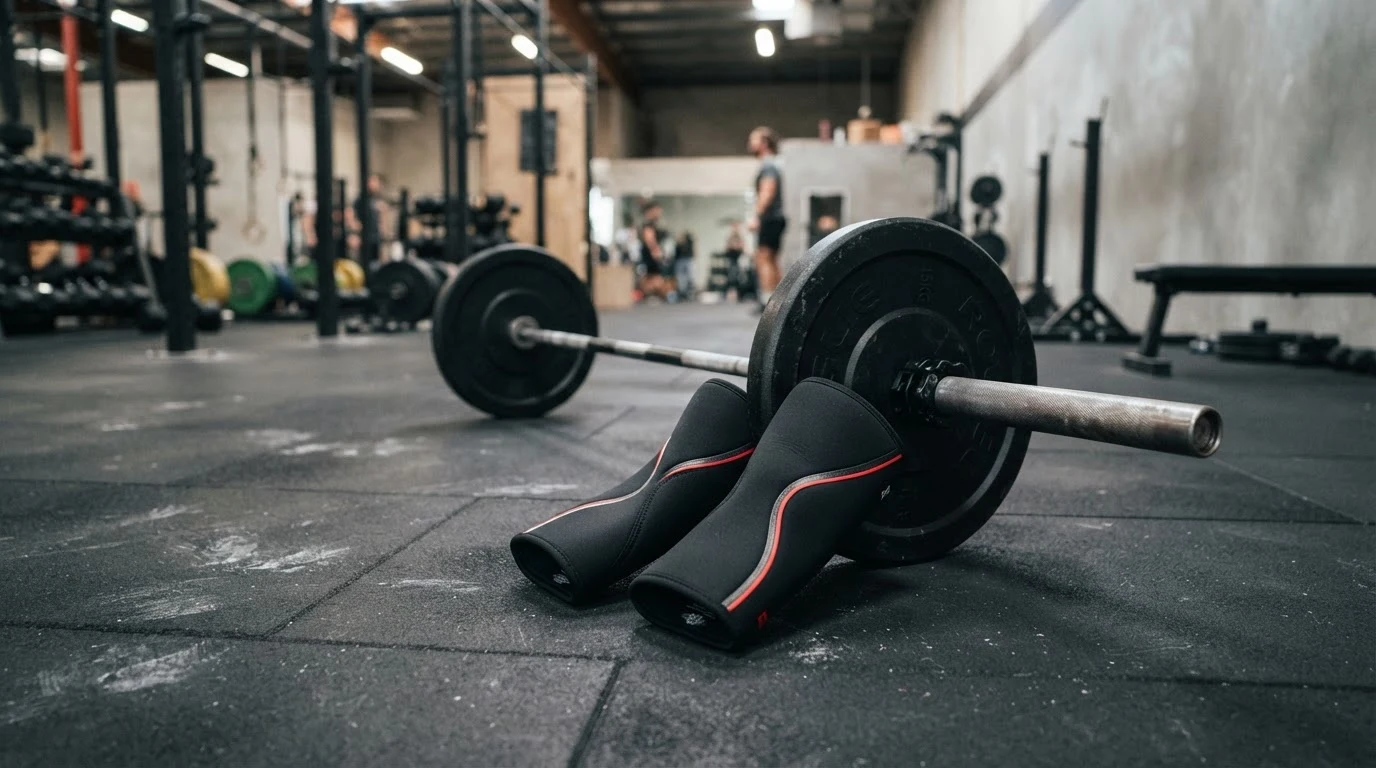
Updated July 2026. The best knee sleeves for lifting and CrossFit provide compression, warmth, and support without restricting your range of motion. After testing twelve different pairs over the past three years, I’ve narrowed it down to the five that are worth buying. Knee sleeves are not the same as knee wraps. Wraps are designed for max lifting with significant elastic support. Sleeves are designed for comfort, compression, and joint health during training. I wear knee sleeves for all squat and deadlift sessions, and I’ve noticed a significant difference in how my knees feel the next day. Below are my recommendations based on personal testing, price, durability, and performance.
1. SBD Knee Sleeves
SBD sleeves are the gold standard for powerlifting. They’re made from a thick, dense neoprene that provides the most support of any sleeve on this list. They’re also the most expensive at $80 to $100 per pair. I’ve been using the same pair of SBDs for two years, and they’re still as supportive as the day I bought them. The 7mm thickness is ideal for heavy squats and deadlifts. The only downside is that they can be difficult to put on and take off, especially between events in a competition. If you’re a serious lifter, SBD is the best investment you can make for your knees.
2. Rehband Knee Sleeves
Rehband is the original knee sleeve brand and still one of the best. They offer 5mm and 7mm thickness options. The 5mm version is more comfortable for everyday training and CrossFit. The 7mm version provides more support for heavy lifting. Rehband sleeves are slightly less supportive than SBDs but more comfortable for longer training sessions. I use Rehband 5mm sleeves for most of my training and switch to SBDs for heavy squat days. At $60 to $80 per pair, they’re a good mid-range option that will last at least a year with regular use.
3. Stoic Knee Sleeves
Stoic sleeves are the best budget option. They’re 7mm neoprene, similar to SBDs, but cost about half the price at $40 to $50 per pair. The support is excellent for the price, though the durability is not quite as good as SBD or Rehband. I’ve had a pair of Stoics that lasted about eight months before the neoprene started to lose its elasticity. For the price, that’s still a good value. If you’re on a budget or just starting with knee sleeves, Stoic is a solid choice.
4. Hookgrip Knee Sleeves
Hookgrip sleeves are popular among weightlifters and CrossFit athletes. They’re 5mm neoprene with a tapered design that fits well around the calf and thigh. The compression is even and comfortable, and they don’t pinch behind the knee. Hookgrip sleeves are the most comfortable option for high-rep work and Olympic lifting. They’re less supportive than the 7mm options, but they’re also more breathable and easier to wear for long sessions. At $50 to $65 per pair, they’re a good mid-range option.
5. RockTape Knee Sleeves
RockTape sleeves are designed for CrossFit and functional fitness. They’re 5mm neoprene with a slightly different cut that accommodates a wider range of motion. The compression is firm but not restrictive. RockTape sleeves are the best option for CrossFit athletes who need knee support for squats, box jumps, and lunges without the bulk of a 7mm sleeve. At $55 to $70 per pair, they’re competitively priced and durable.
How to Choose the Right Knee Sleeve Thickness
Knee sleeves come in 5mm, 7mm, and sometimes 9mm thicknesses. The 5mm sleeves are best for general training, CrossFit, and rehabilitation. They provide compression and warmth without significant lifting assistance. The 7mm sleeves are best for powerlifting and heavy strength training. They provide noticeable support and can add 5 to 10 pounds to your squat by improving your confidence in the bottom position. The 9mm sleeves are rare and typically used only by competitive powerlifters. I recommend most lifters start with 5mm sleeves and upgrade to 7mm if they feel they need more support. I used 5mm Rehbands for a year before switching to 7mm SBDs, and the transition was smooth.
How to Measure for Knee Sleeves
Proper sizing is critical for knee sleeves. Sleeves that are too loose won’t provide support. Sleeves that are too tight will restrict blood flow and be uncomfortable. Measure the circumference of your knee at the center of the kneecap with your leg straight. Then measure the circumference of your thigh 6 inches above the knee and your calf 6 inches below the knee. Use the largest measurement to determine your size, then check the manufacturer’s sizing chart. Most brands have slightly different sizing, so always check the specific chart for the brand you’re buying. If you’re between sizes, go with the larger size for 5mm sleeves and the smaller size for 7mm sleeves. I wear a size large in SBD and a size medium in Rehband, which illustrates how much sizing varies between brands.
Frequently Asked Questions
Do knee sleeves help with knee pain?
Knee sleeves can help with mild knee pain by providing compression and warmth, which increases blood flow to the joint. They are not a cure for knee injuries. If you have chronic or severe knee pain, consult a doctor or physical therapist.
Can you wear knee sleeves for running?
Knee sleeves are designed for lifting, not running. The thick neoprene can be uncomfortable and restrictive for running. If you need knee support for running, look for a compression sleeve designed specifically for running.
How tight should knee sleeves be?
Knee sleeves should be tight enough to provide compression and support but not so tight that they restrict blood flow or cause discomfort. If your leg changes color or you lose sensation in your foot, the sleeves are too tight.
Are knee sleeves allowed in competition?
Yes, knee sleeves are allowed in most powerlifting and weightlifting competitions. Different federations have different rules about sleeve thickness. Some federations limit sleeves to 7mm thickness. Check your federation’s rules before competing.
How long do knee sleeves last?
With regular use, quality knee sleeves last 6 to 12 months. The neoprene loses elasticity over time, especially if you wash them frequently. Hand washing and air drying extends their lifespan. Machine washing and drying damages the neoprene.
Written by Paul Vandyken, fitness coach and competitive powerlifter. Updated July 2026.
Knee Sleeves vs Knee Wraps: What’s the Difference?
Knee sleeves and knee wraps serve different purposes. Sleeves are made from thick neoprene and provide compression, warmth, and mild support. They’re designed to be worn throughout your training session and are comfortable enough for long periods. Wraps are made from elastic cloth and are wrapped tightly around the knee before a heavy set, then removed after the set. Wraps provide significantly more support and can add 20 to 30 pounds to your squat by storing elastic energy at the bottom of the movement. However, wraps are uncomfortable for long periods and take time to wrap and unwrap between sets. For most lifters, I recommend sleeves for everyday training and wraps only for competition or max-effort work. I use sleeves for all my regular training and only break out the wraps for heavy singles above 90% of my max. The added support from wraps is real, but it comes at the cost of comfort and convenience.
How to Care for Your Knee Sleeves
Proper care will extend the life of your knee sleeves significantly. After each use, turn them inside out and let them air dry. The sweat and bacteria that accumulate inside the sleeves will break down the neoprene faster if you leave them in your gym bag. Hand wash your sleeves every two to three weeks with mild soap and cold water. Do not machine wash or machine dry your knee sleeves. The heat and agitation will damage the neoprene and reduce the elasticity. I’ve seen lifters destroy $100 SBD sleeves in two months by machine washing them. My two-year-old SBDs still look and perform like new because I hand wash them and air dry them. If your sleeves start to smell, soak them in a mixture of water and white vinegar for 30 minutes, then rinse and air dry. This kills the bacteria that causes the odor without damaging the neoprene.
When to Replace Your Knee Sleeves
Knee sleeves don’t last forever. The neoprene gradually loses its elasticity, and the sleeves become less supportive over time. You should replace your knee sleeves when you notice any of these signs: the sleeves no longer stay in place during squats and slide down your legs, the compression feels noticeably looser than when you bought them, the neoprene has visible cracks or tears, or the sleeves no longer provide the same level of knee support during heavy lifts. For most lifters training three to four times per week, knee sleeves last about 6 to 12 months. If you’re training less frequently or using them only for heavy sessions, they can last 18 months or longer. I keep two pairs in rotation — one for heavy training and one for lighter sessions. This extends the life of both pairs because they have time to recover their shape between uses.
Knee Sleeves for CrossFit vs Powerlifting
The best knee sleeve for you depends on your training style. CrossFit athletes need sleeves that provide compression and warmth without restricting the range of motion needed for Olympic lifts, box jumps, and lunges. A 5mm sleeve from Hookgrip or RockTape is ideal for CrossFit. Powerlifters need sleeves that provide maximum support for heavy squats. A 7mm sleeve from SBD or Rehband is the better choice for powerlifting. If you do both types of training, consider owning two pairs. I use 5mm Rehbands for my conditioning and accessory work and 7mm SBDs for my heavy squat and deadlift days. This gives me the best of both worlds without compromising on support or comfort. The investment in two pairs of sleeves is worth it if you train seriously.
What I Learned Testing 12 Knee Sleeves
Over the past three years, I’ve tested knee sleeves from SBD, Rehband, Stoic, Hookgrip, RockTape, Gymreapers, Nordic Lifting, Bear KompleX, Rogue, Element 26, 2POOD, and Strength Shop. The five I recommended above are the ones I would buy again. Here’s what I learned from the ones that didn’t make the cut. The biggest factor in knee sleeve performance is the neoprene quality, not the brand name. Some lesser-known brands use neoprene that loses elasticity within a few months, while premium brands like SBD and Rehband use higher-quality neoprene that lasts much longer. The second factor is the cut and fit. Some sleeves are tapered, some are straight, and some have a contoured design. The fit around the calf is particularly important. If the sleeve is too loose at the calf, it will ride up during squats. If it’s too tight, it will pinch behind the knee. The third factor is the stitching. Double-stitched seams last significantly longer than single-stitched seams. I returned a pair of sleeves within a month because the seam split during a squat. The moral of the story is that you get what you pay for with knee sleeves. A $40 pair will work for a while, but a $90 pair will work for years.
Do Knee Sleeves Actually Make You Stronger?
This is a controversial question in the lifting community. Knee sleeves provide compression and warmth, which can improve proprioception and confidence under the bar. The psychological effect of wearing sleeves is real. Many lifters feel more confident squatting heavy weight with sleeves on, and that confidence translates to better performance. The physical effect of sleeves is more modest. The 7mm sleeves provide some elastic support at the bottom of the squat, which can help you bounce out of the hole. But the support is minimal compared to knee wraps. Studies have shown that knee sleeves can increase squat performance by 2 to 5 percent, which is meaningful but not dramatic. The primary benefit of knee sleeves is joint health and comfort, not performance enhancement. I wear sleeves because my knees feel better after training, not because I think they’re adding 20 pounds to my squat. If you’re buying sleeves for the performance boost, you’ll be disappointed. If you’re buying them for joint comfort and injury prevention, you’ll be satisfied.
This content is for general information only and is not medical advice. Consult a physician before starting any exercise or nutrition program.