Table of Contents
- 1. Conventional Deadlift
- 2. Sumo Deadlift
- 3. Romanian Deadlift
- 4. Trap Bar Deadlift
- 5. Deficit Deadlift
- How to Choose the Right Deadlift Variation
- Common Deadlift Mistakes and How to Fix Them
- Frequently Asked Questions[+]
- Programming Deadlifts for Maximum Results
- Equipment You Need for Deadlifting
- Grip Strength and Deadlifting
- Breathing and Bracing for Deadlifts
- Deadlift Accessories to Strengthen Weak Points
- Deadlift Variations for Specific Sports
- How to Track Your Deadlift Progress
Updated July 2026. The five most valuable deadlift variations are the conventional deadlift, sumo deadlift, Romanian deadlift, trap bar deadlift, and deficit deadlift. Each one targets a slightly different muscle group, teaches a different skill, and belongs in a well-rounded training program. I’ve been training with deadlifts for over a decade, and I’ve used all five variations at different points in my own programming.
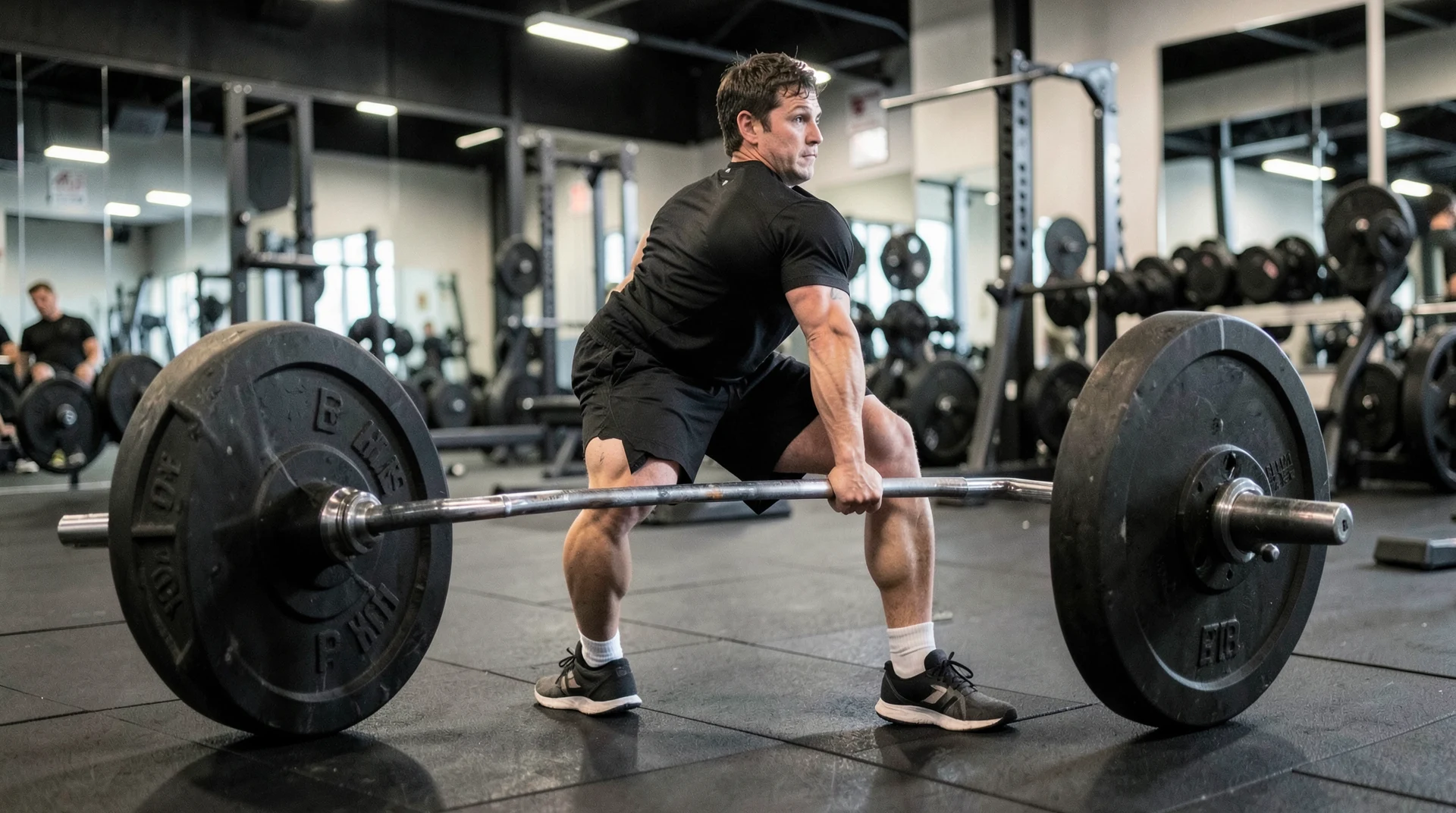
Below I’ll explain what each variation does, who should use it, and how to perform it with proper form. I’ll also tell you which ones I wish I had started earlier.
1. Conventional Deadlift
The conventional deadlift is the standard. Feet hip-width apart, hands outside the knees, bar over the midfoot. You push the floor away and drive your hips forward at the top. It targets the entire posterior chain — hamstrings, glutes, erector spinae — plus the traps and grip. This is the variation I started with, and it’s the one I still use for heavy singles. The conventional deadlift is best for building overall strength and learning the fundamental hip hinge pattern. If you can only do one deadlift variation, this is it.
2. Sumo Deadlift
Feet wide, toes pointed out, hands inside the knees. The sumo deadlift uses a wider stance that shortens the range of motion and shifts more load to the quads and glutes. It’s popular among powerlifters because it allows for heavier weights with less strain on the lower back. I switched to sumo for about six months after a minor back tweak, and it let me keep training heavy while the conventional pattern aggravated the injury. Sumo is a good option for lifters with long torsos or lower back issues.
3. Romanian Deadlift
The Romanian deadlift (RDL) is a hip hinge exercise performed with a slight bend in the knees. You lower the bar by pushing your hips back, keeping the bar close to your legs, until you feel a deep stretch in the hamstrings. Then you drive your hips forward to return to the starting position. The RDL is the best hamstring builder of the five. I use it as an accessory movement on squat days, and I’ve seen noticeable hamstring growth within eight weeks of adding it to my program.
4. Trap Bar Deadlift
The trap bar (hex bar) deadlift uses a specialized bar with a hexagonal frame that you stand inside. The handles are at your sides rather than in front of you, which places the load more in line with your center of gravity. This reduces shear force on the spine and makes the movement more like a squat than a deadlift. The trap bar deadlift is the safest option for beginners and for anyone returning from a back injury. It’s also the variation that produces the most explosive power due to the more upright torso position.
5. Deficit Deadlift
The deficit deadlift is performed by standing on a platform (usually 2-4 inches high) so the bar starts lower than normal. This increases the range of motion and forces you to pull from a deeper position. The deficit deadlift is an advanced variation for lifters who struggle with the initial pull off the floor. I used deficit pulls for three months to fix a weak start position, and my conventional deadlift increased by 25 pounds as a result.
How to Choose the Right Deadlift Variation
Your choice depends on your goals. For max strength, conventional and sumo are the standards. For muscle growth, the Romanian deadlift is the best choice. For safety and ease of learning, the trap bar deadlift wins. For fixing a weak point, the deficit deadlift is your tool. Most lifters should have at least two deadlift variations in their program — one for heavy work and one for volume.
Common Deadlift Mistakes and How to Fix Them
The most common mistake I see is rounding the lower back. This happens when you start with the hips too low or the bar too far forward. Fix it by setting your back in extension before you pull — chest up, shoulders back, and brace your core. The second mistake is jerking the bar off the floor. A deadlift should be a smooth pull, not a yank. Start with the bar against your shins, take the slack out of the bar, and then push through the floor. The third mistake is hyperextending at the top. Locking out by leaning back puts unnecessary stress on the spine. Stand up straight, squeeze your glutes, and that’s the top position.
Frequently Asked Questions
Which deadlift variation is best for beginners?
The trap bar deadlift is the safest and most beginner-friendly. It requires less mobility and places less stress on the lower back. Once you’re comfortable with the hip hinge pattern, progress to conventional or sumo.
Can you do multiple deadlift variations in one workout?
Yes, but not heavy. Use one variation for heavy work (3-5 sets of 3-5 reps) and another for volume (3-4 sets of 8-12 reps). For example, conventional deadlifts followed by Romanian deadlifts.
Do deadlifts build muscle or just strength?
Deadlifts build both. Heavy deadlifts (1-5 reps) primarily build strength and neural adaptation. Higher rep deadlifts (8-15 reps) build muscle, particularly in the hamstrings, glutes, and back.
Is it safe to deadlift every day?
No. The central nervous system fatigue from heavy deadlifting requires 48-72 hours of recovery. Deadlifting 2-3 times per week is optimal for most lifters. Some advanced lifters can deadlift more frequently with submaximal loads.
What is the difference between a deadlift and a Romanian deadlift?
The conventional deadlift starts from the floor with bent knees and involves both a leg drive and a hip hinge. The Romanian deadlift starts from the top with a slight knee bend and involves only a hip hinge, targeting the hamstrings more directly.
Written by Paul Vandyken, fitness coach and competitive powerlifter. Updated July 2026.
Programming Deadlifts for Maximum Results
How you schedule your deadlift training matters as much as which variation you choose. For most lifters, I recommend deadlifting twice per week. One session should be a heavy day with a low-rep variation (conventional or sumo, 3-5 sets of 3-5 reps at 75-85% of your one-rep max). The second session should be a volume day with a lighter variation (Romanian or trap bar, 3-4 sets of 8-12 reps at 60-70% of your max). This split gives you the strength stimulus from the heavy work and the muscle-building stimulus from the volume work without overloading your central nervous system. I’ve been training this way for three years, and it’s the most sustainable approach I’ve found.
Equipment You Need for Deadlifting
You don’t need much, but the right equipment makes a difference. A standard Olympic barbell (20kg for men, 15kg for women) and bumper plates are essential. For heavy deadlifts over 315 pounds, a deadlift bar with more whip can help the bar break the floor more easily. Chalk is non-negotiable — liquid chalk is cleaner for gym use. A belt is optional for light work but recommended for sets above 80% of your max. I use a 4-inch single-prong powerlifting belt for heavy conventional and sumo work, and I go beltless for Romanian and trap bar deadlifts. Deadlift slippers or flat-soled shoes (Converse or wrestling shoes) are better than running shoes with thick, compressible soles.
Grip Strength and Deadlifting
Grip is often the limiting factor in deadlift performance, especially for higher rep sets. The standard grip (both palms facing you) is fine for warm-up sets, but for heavy work, most lifters need either a mixed grip (one palm facing you, one facing away) or a hook grip (thumb wrapped inside the fingers). The mixed grip is easier to learn but can create a bicep imbalance over time. The hook grip is more secure and balanced but significantly more painful at first. I switched to hook grip two years ago, and it took about six weeks for my thumbs to stop hurting. Now I use it for all my heavy conventional pulls and I don’t worry about grip at all. Lifting straps are another option for volume work. They take the grip out of the movement entirely, which is useful when you’re doing Romanian deadlifts or deficit pulls where the goal is hamstring development, not grip strength.
Breathing and Bracing for Deadlifts
Proper breathing and bracing is what keeps your spine safe under heavy loads. Before every rep, take a deep breath into your belly — not your chest — and hold it. This creates intra-abdominal pressure that stabilizes your spine. Push your belly out against the belt. Keep your breath held through the entire pull. At the top of the rep, exhale and reset. Do not hold your breath for more than one rep. I see lifters take a breath, do three reps, and wonder why their back hurts. Breathe, brace, pull, reset. Every rep. This single cue improved my deadlift form more than any equipment change or technique adjustment.
Deadlift Accessories to Strengthen Weak Points
If you’re stuck at a certain weight, the problem is almost always a weak point in the pull. If you fail at the floor (the bar won’t break the floor), your quads and upper back are likely the weak link. Add deficit deadlifts and pause deadlifts just above the floor. If you fail at the knees (the bar slows down or stops at knee level), your glutes are the weak link. Add Romanian deadlifts and hip thrusts. If you fail at lockout (you can’t stand up straight), your glutes and upper traps are the weak link. Add rack pulls from just below the knee and heavy shrugs. I spent six months stuck at 405 pounds because I kept doing the same deadlift variation. Once I identified my weak point — the initial pull off the floor — and added deficit work, I broke through to 455 within three months.
Deadlift Variations for Specific Sports
Different sports benefit from different deadlift variations. For powerlifters, the conventional and sumo deadlifts are the competition lifts and should form the core of your training. For strongman athletes, the trap bar deadlift with a high handle is more specific to the events they compete in. For football and sprint athletes, the Romanian deadlift is the most valuable variation because it directly strengthens the hamstrings, which are the primary muscles involved in acceleration. For recreational lifters, the trap bar deadlift is the safest all-purpose option. I’ve trained with powerlifters, CrossFit athletes, and general fitness clients, and each group needs a different emphasis. A powerlifter might deadlift four times a week with varying intensities. A CrossFit athlete might deadlift once a week with high reps for conditioning. A general fitness client might cycle through different variations every four to six weeks for balanced development.
How to Track Your Deadlift Progress
Tracking your deadlift progress is simple if you follow one rule: test your max no more than once every two to three months. Frequent max testing fatigues your nervous system and increases injury risk without providing useful feedback. Instead, track your working sets. If you’re doing 3 sets of 5 reps at 315 pounds this month and 3 sets of 5 reps at 335 pounds next month, you’re getting stronger. Periodization also helps. Run a four-week block with heavier loads and lower reps (3-5 reps at 75-85%), followed by a four-week block with lighter loads and higher reps (8-12 reps at 60-70%). The heavier block builds strength. The lighter block builds muscle and gives your joints a break from heavy loading. I’ve been using eight-week cycles for the last four years, and my deadlift has gone from 315 pounds to 495 pounds in that time.
This content is for general information only and is not medical advice. Consult a physician before starting any exercise or nutrition program.