Table of Contents
 Push-ups barely touch your biceps. When researchers wired up both arms during a set of floor push-ups, the biceps registered about 8% of its maximum activation while the triceps registered near 34%. Your biceps are holding the elbow steady while your chest, shoulders and triceps do the pressing.
Two push-up variations are worth your time anyway, one because it has been measured and one because the mechanics argue for it. A short list of bodyweight moves builds arms properly when size is what you are after. You get both, along with the variations that get sold as biceps work and do nothing of the sort.
What Your Biceps Are Actually For
 Your biceps brachii sits on the front of your upper arm and has two jobs. It turns your palm upward, and it helps bend your elbow. Anatomy references describe it as a strong supinator of the forearm and a weak elbow flexor. The brachialis, a separate muscle sitting underneath, does most of the actual bending.
The brachialis is a separate muscle, and it is not one of the biceps heads, however often the two get lumped together. Your biceps has two heads, the long head and the short head, and both cross the shoulder as well as the elbow.
A push-up asks the opposite of your elbow. You straighten it against your own bodyweight, and straightening the elbow is what the triceps exist to do. The movement that defines a push-up is the reverse of your biceps’ main job, which is why the load lands where it does.
So How Much Do Push-Ups Really Work Your Biceps?
 About 8% of maximum, and the figure comes from electromyography. A 2014 study published in BMC Research Notes put surface electrodes on 20 trained men and recorded their arms through push-ups on the floor and on a suspension trainer. Both a static hold and a set of reps were recorded.
Each figure is that muscle’s share of its own peak activity, so 8% and 34% describe two completely different levels of engagement.
| Muscle | Floor, static hold | Floor, reps | Suspension, static hold | Suspension, reps |
|---|---|---|---|---|
| Biceps brachii | 6.5% | 8.0% | 14.9% | 19.4% |
| Triceps brachii | 20.0% | 33.6% | 25.5% | 39.8% |
On the floor your triceps show roughly four times the muscle activity your biceps do. Taking the stable floor away more than doubles biceps involvement, and even doubled, 19% of maximum is what a muscle contributes while it braces a joint.
Why Your Arms Stopped Changing
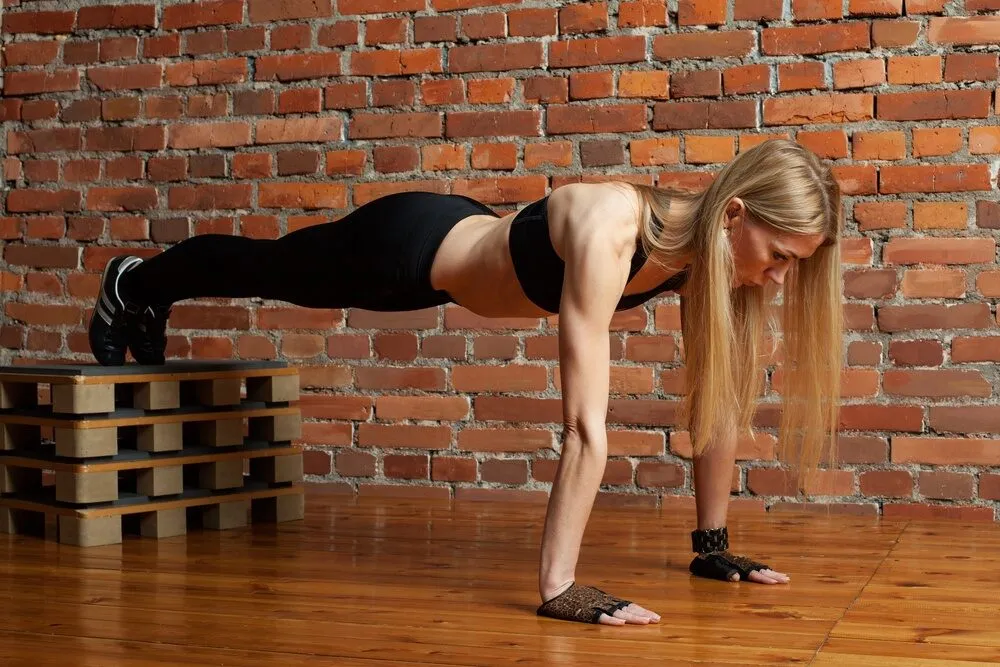 A muscle grows when it is loaded hard enough, often enough, with the load creeping up as it adapts. Your biceps gets none of that in a push-up. It braces a joint angle at a small fraction of its capacity while other muscles move you, and thirty reps of bracing is still bracing.
Every year someone tells me they did a hundred push-ups a day for a month and their arms look the same. They usually do look the same. Their chest and triceps changed, their push-up numbers went up, and their upper arms stayed exactly where they were.
More reps will not fix that, because more reps of a movement your biceps barely participates in gives you a bigger dose of nothing. You have two ways out. Change what the arm is doing during the press, or add real elbow-bending work to your training week.
The Push-Up Variations That Come Closest
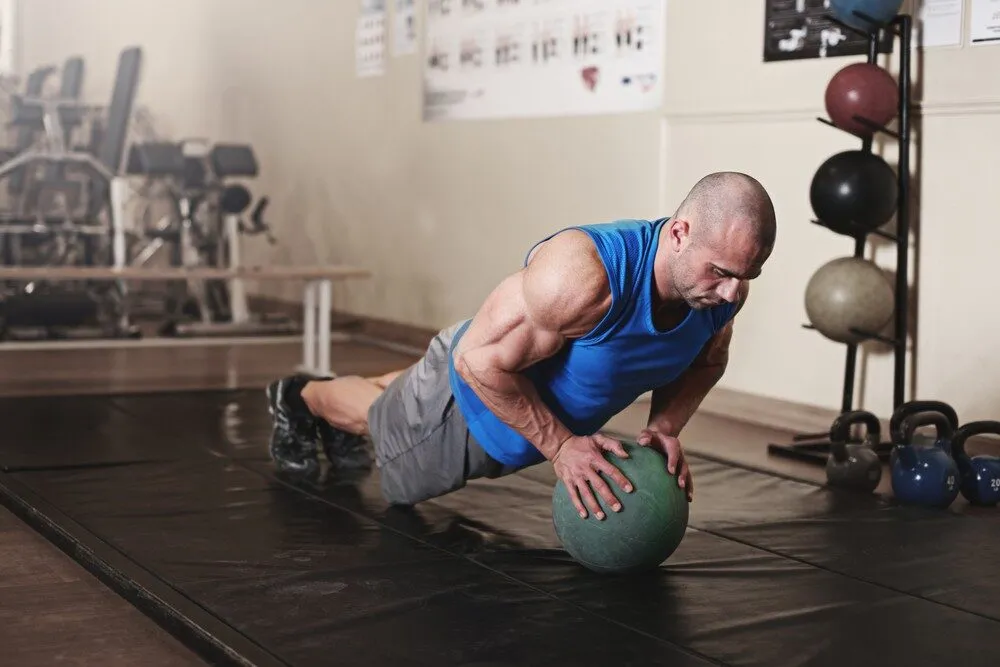 Two variations change the job your arms are doing. The rest of the list just makes the press harder. Suspension push-ups take the floor away, so your arms spend the whole set resisting rotation and drift. Reverse-grip push-ups turn your hands to face backwards, which puts the forearm in supination and gives the elbow flexors something to fight. Everything else on the popular list moves work between chest and triceps.
Some of them only sound like arm work, and that sorts itself out fast once you rate them on what they change.
| Variation | What it changes | Evidence for biceps | Verdict |
|---|---|---|---|
| Suspension or ring push-up | Removes the stable floor; arms resist rotation all set | Measured: 19.4% vs 8.0% on the floor | The one with numbers behind it. Start here. |
| Reverse-grip push-up | Supinated forearm, elbow flexors loaded isometrically | No published EMG study found | Best mechanical case. Your wrists and elbows pay for it. |
| One-arm push-up | Doubles the load per arm, heavy stabiliser demand | None specific to biceps | A strength skill worth owning. Still a pressing movement. |
| Close-grip or diamond push-up | Elbows tuck to the ribs | Sends work to the triceps | The most common piece of bad biceps advice going. |
| Feet-elevated push-up | Shifts more bodyweight onto the arms | No shift in which muscle presses | Harder overall. Same muscles doing the work. |
An unstable surface is the only modification here that has been measured and found to change what your biceps does. Everything else in that list rests on mechanics and reasoning.
Suspension Push-Ups
Hook a suspension trainer at about hip height, a TRX or a set of gymnastic rings, grip the handles with your palms facing each other, and press. Your arms will shake on the first session. That shake is the point, because holding the handles in line is the work the floor normally does for you.
Start at a shallow angle with your feet well forward and your body close to upright. Three sets of eight, resting two minutes, is plenty for a first week. Lower the anchor or walk your feet back once the shake settles down, which for most people takes a few sessions.
Reverse-Grip Push-Ups
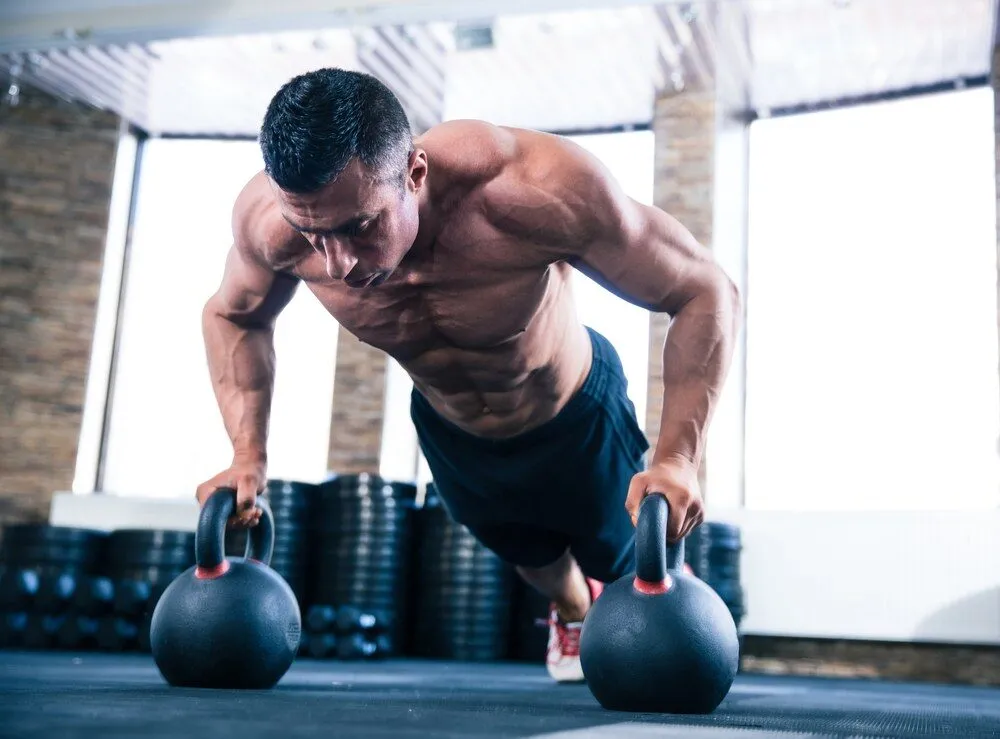
Turn your hands so the fingers point back toward your feet, keep them under your shoulders instead of out wide, and keep your elbows brushing your ribs the whole way down. Rotate only as far back as your wrists allow, which for many people is a diagonal short of a full reversal. Done properly you will feel it high in the front of the arm.
It also puts your wrists into hard extension and drags on the elbow tendons, and most people are not ready for that cold. Do them on an incline first, hands on a bench or a kitchen counter, and give your wrists and forearms a proper warm-up beforehand.
Five to eight reps on an incline, two or three sets, twice a week. Any elbow pain that lingers into the next day means you went to the floor too early.
One-Arm Push-Ups
Take one hand off the floor, put it on your lower back, widen your feet for balance, and press with the hand underneath your chest. Your whole trunk fights the rotation, which is why this one humbles people who can do forty regular push-ups.
The old advice on this page said to start with ten reps per arm. Ignore that. Almost nobody gets a clean first rep from the floor. Build it on a wall, then a counter, then a bench, then a low step, staying at each height until five smooth reps per side feel easy. In my experience that progression runs a couple of months for most people, and rushing it is how wrists get angry.
What I Give People Who Actually Want Bigger Arms
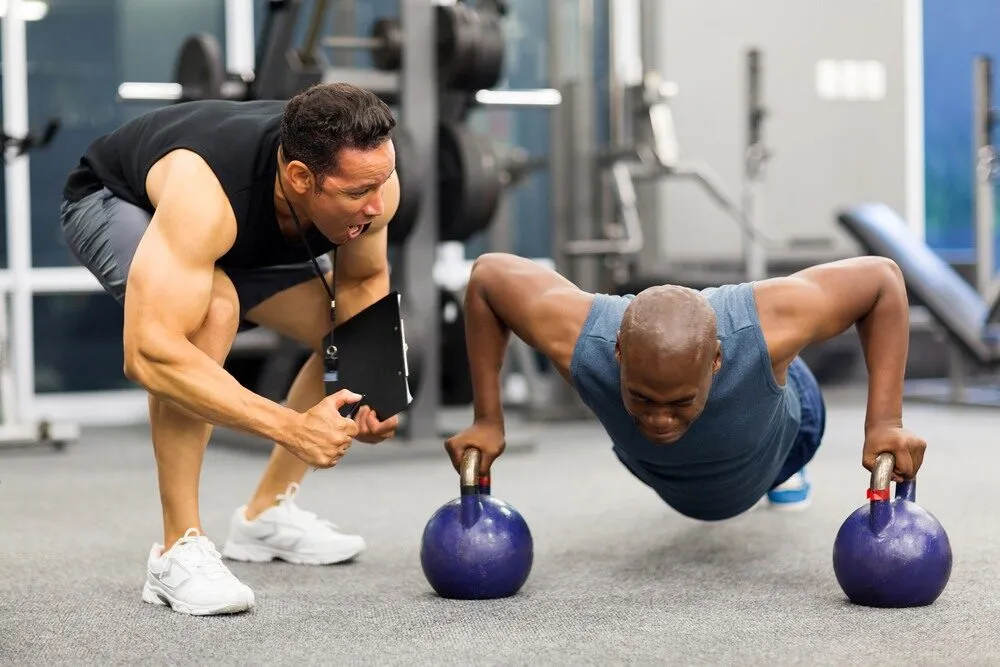 Bend the elbow against resistance. That is the whole requirement, and every option here meets it without a gym membership. When the American Council on Exercise funded a study at the University of Wisconsin-La Crosse comparing eight biceps exercises across 16 people, the concentration curl produced significantly more biceps activation than any of the other seven, and every exercise on that list, chin-ups included, bends the elbow against load.
Chin-ups are the strongest bodyweight option, palms facing you, because that grip puts the forearm in the supinated position where your biceps is strongest. Can’t do one yet? Hang at the top and lower yourself slowly, five seconds a rep, five reps.
Inverted rows come next. Lie under a sturdy table or a bar set at hip height, grip it underhand, and pull your chest to it. Adjust difficulty by walking your feet in or out. Three sets of ten, and if ten is easy, straighten your legs.
For loaded curls with no dumbbells, fill a backpack with books and curl it, or curl one end of a towel while your other hand pulls against it. Neither is elegant. Both bend the elbow against resistance, which is the only thing your biceps is asking for. If you end up wanting a dedicated tool, an arm blaster keeps your elbows pinned so the curl stays on the muscle.
Fix The Basic Push-Up First
 None of the variations above are worth attempting until your standard push-up is solid, because every one of them amplifies whatever your form is already doing. Hands under your shoulders. Body in one line from heel to head. Chest to the floor, then press away without your hips arriving first.
Can’t hold that line yet? Drop to your knees and keep everything else identical, torso and thighs still forming one straight plank. Knee push-ups are the regression that works, and they beat sloppy full-range reps every time.
Ten clean knee push-ups, three sets, three days a week. When the third set stops being hard, move your hands to a bench and work down toward the floor a step at a time. If one shoulder consistently drops during the press, that is an imbalance to address before you add load.
Mistakes That Waste The Set
I correct these five more often than anything else. Each one either takes load off the muscles you are trying to reach or parks it somewhere your joints will complain about later.
- Elbows flaring straight out to the sides. Tuck them nearer your ribs, at something like a forty-five degree angle, and the shoulder joint has a far easier time.
- Hips sagging or piking. Squeeze your glutes and brace your midsection before the first rep, then hold that.
- Half reps. Chest to within a fist of the floor or the rep does not count.
- Racing the tempo. Two seconds down, one second up, and the set gets harder without adding a single rep.
- Chasing soreness. Post-exercise soreness is a poor guide to whether a session did anything, and a 2013 review by Brad Schoenfeld and Bret Contreras in the Strength and Conditioning Journal lists five separate lines of evidence against using it that way.
Soreness deserves a longer answer, because it drives a lot of pointless training. It tracks novelty and eccentric load far more closely than it tracks growth. Marathon runners finish sore and gain almost no muscle from the run.
FAQ
Should I feel push-ups in my biceps?
Treat it as a positioning signal. Hands that have drifted forward of your shoulders leave the elbow flexors bracing an angle they were never meant to hold, and wrists collapsing inward do the same thing. Reset the hand position and the sensation usually moves back where it belongs inside a set or two. A dull ache spreading through the arm is fatigue. A sharp point right at the elbow crease means stop for the day.
Do resistance bands count as proper biceps work?
They do, with one quirk worth planning around. Band tension climbs as the band shortens, so a band curl is hardest at the top and nearly weightless down in the stretched position. Stand on the band with both feet to add load, pause a beat at the top where the tension actually is, and take each set close enough to failure that the final two reps slow down visibly.
How many push-ups a day should I do if arms are the goal?
Switch the unit you are counting. Hard sets drive change, daily totals mostly drive habit, and three or four sets taken within a couple of reps of failure will out-perform any amount of comfortable volume. If you are already deep into a daily push-up challenge and enjoying it, keep it, and treat it as conditioning that happens to involve your arms.
How long before bodyweight arm work shows?
Strength moves first, and it shows up as extra reps before it shows up as size. Going by the people I coach, that is a matter of weeks. Visible change in the upper arm runs closer to a season of consistent work, and it depends as much on what you eat as on what you lift. Anyone promising visibly bigger arms in a fortnight is selling something.
Do push-ups help arm definition even if they do not build biceps?
Yes, and the reason has more to do with your kitchen than your training. Definition is what you see when there is little body fat sitting over a muscle, so the fastest route to a sharper arm is usually a calorie deficit rather than another set. Push-ups earn their place in that picture by thickening the triceps, which is what gives the back of the arm its outline.
Push-ups build chest, shoulders and triceps anywhere there is floor space, and they do close to nothing for your biceps. Take the suspension variation for the measurable bump, add reverse-grip work on an incline if your wrists tolerate it, and put chin-ups or rows in your week for the arms themselves. Then give it a full season before you judge the result.
This content is for general information only and is not medical advice. Consult a physician before starting any exercise or nutrition program.


Leave a Reply
You must be logged in to post a comment.